Cartoon
Added in version 3.17.0.
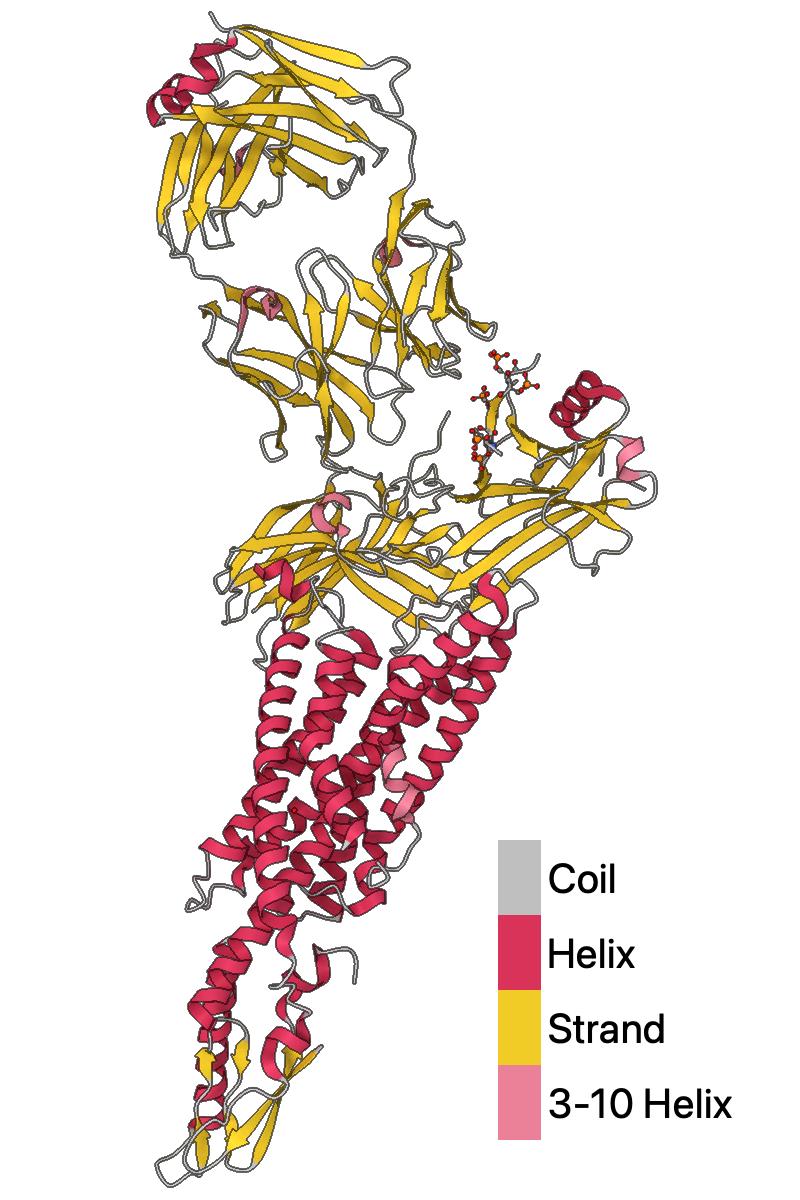
A cartoon data object stores the backbone trace of a protein structure, which forms the basis of the cartoon representation (helices as ribbons, beta strands as arrows, coil as tubes). The PDB and mmCIF file readers create this object automatically whenever the imported structure contains amino-acid residues. The appearance of the cartoon in rendered images is controlled by the associated cartoon visual element.
|
|
Cartoon representation of PDB entry 27EM, colored by secondary structure type. |
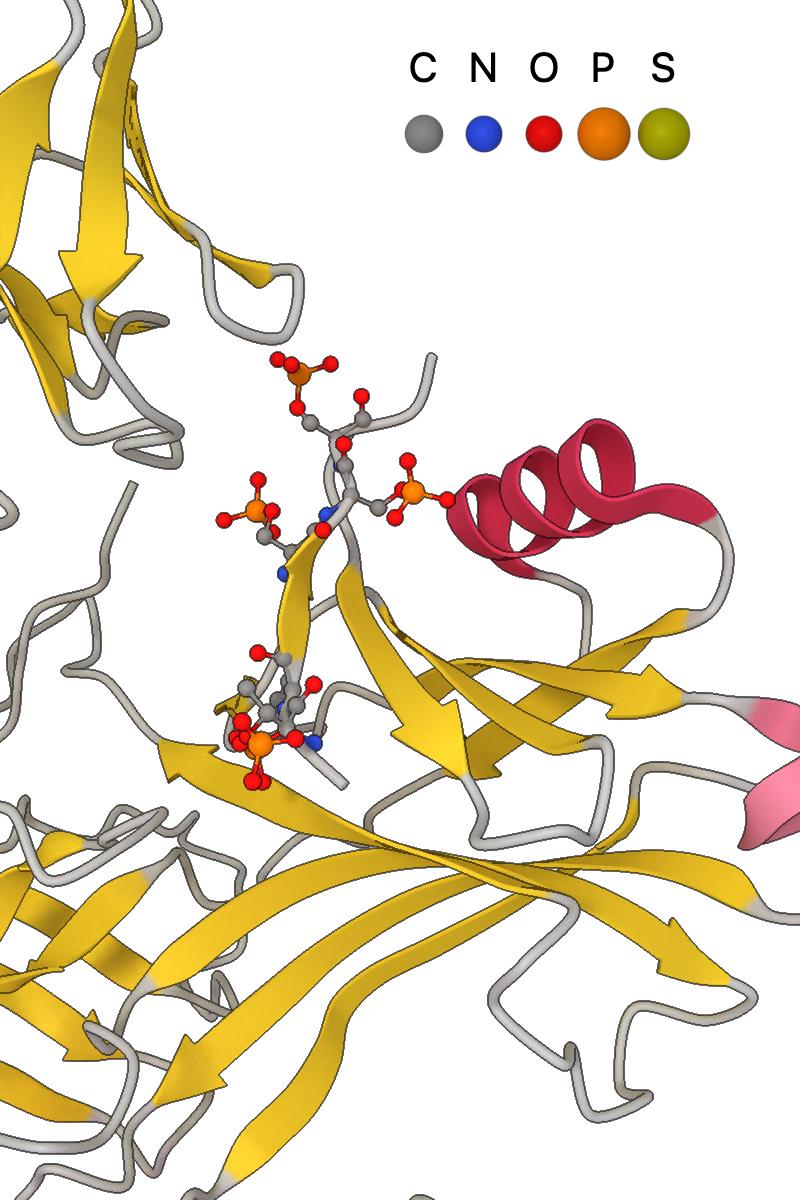
Close-up of the same structure: the cartoon combined with a ball-and-stick representation of a ligand. |
The cartoon object is a property container with one element per residue covered by the cartoon. It stores the following per-residue properties, which can be inspected in the Cartoon tab of the data inspector:
Property |
Description |
||||||||||||||||||||||||||||||
|---|---|---|---|---|---|---|---|---|---|---|---|---|---|---|---|---|---|---|---|---|---|---|---|---|---|---|---|---|---|---|---|
Secondary Structure |
|
||||||||||||||||||||||||||||||
Chain |
Typed property identifying the polymer chain; the type names are the chain identifiers of the input file. |
||||||||||||||||||||||||||||||
Section |
Identifier of the continuous backbone segment; the file readers start a new section at every chain break. |
||||||||||||||||||||||||||||||
Residue Type |
Typed property using the same numeric IDs as the |
||||||||||||||||||||||||||||||
Particle Index |
Index of the residue’s alpha-carbon atom in the particles container. Determines the position of the residue. |
||||||||||||||||||||||||||||||
Oxygen Index |
Index of the residue’s carbonyl oxygen atom in the particles container (-1 if the residue has no oxygen atom). Determines the ribbon orientation. |
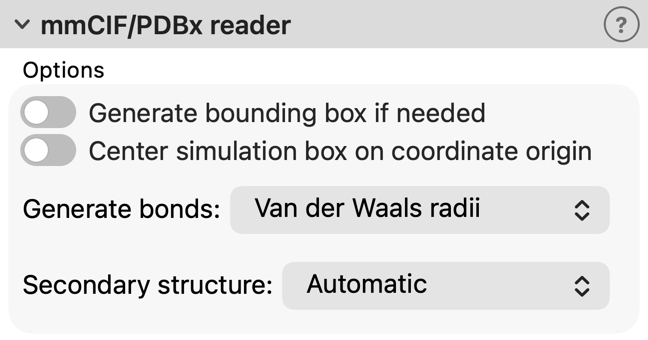
By default, the secondary structure assignments are taken from the HELIX/SHEET records of PDB files and the
_struct_conf/_struct_sheet_range categories of mmCIF files. For chains lacking such records, the file readers compute the
secondary structure from the atomic coordinates using the DSSP algorithm (Kabsch & Sander, 1983). The Secondary structure
option of the PDB and mmCIF file readers lets you
restrict the assignment to the records of the file (From file) or compute it for all chains with DSSP (DSSP).
OVITO’s DSSP results match the implementation of the mkdssp program.
The cartoon object does not store any coordinates. The Particle Index and Oxygen Index properties are references to atoms,
which OVITO automatically keeps up to date when atoms are deleted or reordered by a modifier. The rendered cartoon is built from
the current positions of these atoms, so it follows the motion of the atoms, e.g. when they are displaced or transformed by a modifier
such as Affine transformation, wrapped into the periodic cell by Wrap at periodic boundaries,
or when a separate trajectory file is loaded.
A residue is deleted automatically together with its alpha-carbon atom, e.g. when the atom is removed by the Delete selected or Slice modifier. The oxygen atom is optional: if a residue has no oxygen atom or if it gets deleted, the reference is -1 and the ribbon orientation is derived from the course of the backbone instead. Consecutive residues are connected by the cartoon if they belong to the same section and their alpha-carbon atoms are not further apart than 4.2 Å. The cartoon therefore gets interrupted wherever residues have been deleted.
You can also remove residues from the cartoon while keeping their atoms. The Slice modifier,
operating on the cartoon, deletes or selects residues based on the positions of their alpha-carbon atoms. The
Delete selected modifier deletes the selected residues, e.g. those selected with the
Expression selection modifier operating on the cartoon. The Residue Index of the atoms of deleted residues is set to -1.
Cartoon flags and residue index
In addition to the cartoon object, the file readers attach the Cartoon Flags property to the atoms. It has the two integer components
Hetero and Sidechain:
Heterois 1 for atoms belonging to residues that are not covered by the cartoon (ligands, ions, water, nucleic acids) and for residues marked asHETATMin the input file (e.g. modified amino acids).Sidechainis 1 for all atoms that are not hidden by the cartoon, i.e. hetero atoms and the non-backbone atoms of the traced residues. It is 0 for the backbone atoms (N, CA, C, O and their hydrogens) represented by the cartoon.
These flags let you combine the cartoon with a reduced atomistic representation. For example, use the
Compute property modifier to set the Hidden particle property to the expression
CartoonFlags.Sidechain == 0, which hides the backbone atoms and shows only side chains and hetero groups next to the cartoon,
or to CartoonFlags.Hetero == 0 to show only ligands, ions and water molecules. Alternatively, select the atoms with the
Expression selection modifier and hide them with the Hide selected modifier.
Warning
Since the cartoon is anchored at the alpha-carbon atoms, deleting the backbone atoms (e.g. with the Delete selected modifier) removes the corresponding residues from the cartoon as well. Hide the atoms instead, as shown above, to remove them from the rendered image while keeping the cartoon.
References
See also
ovito.data.Cartoon (Python API)